High tariffs didn't make the U.S. rich in the 19th century. They won't this time.
So…. tariffs are back in the news. Did you hear? On Wednesday, Trump launched his “Liberation Day” tariffs with rates that would make William McKinley blush. I started drafting a response but realized I’d be contributing to the overwhelming flood of instant reactions.
Instead of hot-taking Trump’s move (my general stance isn’t exactly a secret), I thought I’d finish up a related newsletter I had been working on where I answer the questions.
Did high tariffs fuel America’s industrial rise in the 19th century? What does the best research tell us?
This question matters because it underpins so many current arguments. Almost every tariff defender, from Trump to lawyers like Oren Cass, points to America’s 19th-century experience as proof that protection “works.” While they aren’t exactly clear what they mean (rarely offering an explicit causal claim, let alone a model), tariff fans like Cass will say things such as “Behind some of the world’s highest tariff barriers, the United States transformed from colonial backwater to continent-spanning industrial colossus.” That sounds almost causal, possibly even refutable: Tariffs caused the U.S.’s economic success.
But is that right? Put more concretely, did America grow because of or despite those tariffs? As the title more than alludes, I don’t think Cass has the right reading of the economic evidence.
While America’s economy grew rapidly under high tariffs in the late 19th century, recent research strongly suggests tariffs were incidental at best—and probably harmful—to U.S. growth.
Today’s newsletter will go through the best available evidence. The focus is on the 19th-century United States, roughly from the end of the Civil War through the Gilded Age and up to World War I when U.S. tariffs were among the highest in the world.
America: The Protectionist Success Story?
It’s not a completely implausible idea that tariffs help growth. During the late 19th century (circa 1870-1914), several of the fastest-growing economies had relatively high tariffs. The United States and Germany were rapidly industrializing and maintained steep import duties. Britain, by contrast, with its policy of free trade, grew more slowly.
From roughly the Civil War through World War I, the United States maintained staggeringly high tariffs on manufactures, often between 40-50% on dutiable imports.1 While Britain gradually started to embrace free trade after 1846, the U.S. doubled down on protection. The average tariff on all imports was lower, around 30 percent by the 1880s, due to a significant list of duty-free raw materials. Compare this to our European peers. By 1900, Britain had near-zero tariffs on manufactures; Germany and France had moderate tariffs of about 5-15%; but the U.S. was the outlier, with rates sometimes exceeding 40%.
And undeniably, America’s economy boomed during this period. By 1900, the U.S. had overtaken Britain as the world’s leading industrial power. This seems like a slam-dunk case for the protective tariff.
If we look beyond the U.S., Kevin O’Rourke found that this positive correlation between tariff levels and growth rates held up even after controlling for factors like each country’s initial income and investment rates. In other words, around that historical period, the countries with higher tariffs tended to grow faster.
But correlation isn’t causation. Everyone knows this, even if politicians conveniently forget. The real analytical challenge is separating the tariff’s impact from all the other factors that made America grow.
How do we interpret this apparent paradox? Irwin addressed this question in an early review of the 1990s papers with cross-country growth regressions. He suggests several possible explanations:
Causation could run the other way: Countries that were rapidly industrializing might have had the political clout to impose tariffs. Tariffs may have been a consequence of industrial growth, not just a cause.
Omitted variables: Late 19th-century high-growth nations had other common traits like vast internal markets and ongoing nation-building. These fundamentals, not the tariffs, likely drove their growth.
Composition effects: Tariffs often applied to manufactured consumer goods, while many fast-growing economies were big exporters of primary products. The tariff-growth correlation might partly reflect that countries enjoying commodity booms also tended to impose tariffs for revenue.
These possible issues suggest caution in drawing pro-tariff conclusions from these 19th-century correlations. We need to be more careful.
The Boring (But Crucial) Matter of Counterfactuals
When we look at one country in history, we face an N=1 problem. We have no control group. The late 19th century United States also featured explosive population growth, mass European immigration, rapid technological innovation, westward expansion, abundant natural resources, high literacy rates, and stable property rights. Any of these could be the real growth driver.
This is where economic analysis becomes essential and where non-economists on both sides of the debate fall short. Most people rely on temporal coincidences. “America had high tariffs and grew rapidly.” What’s missing is any rigorous attempt to isolate the causal effect of tariffs from all these other factors.
This is not just a minor methodological quibble; it’s the entire ballgame. Without establishing some plausible causation, we are telling just-so stories and not providing evidence of whether tariffs mattered in any sense.
Economics provides tools to address this challenge. A hallmark of good economic analysis is the explicit construction of counterfactuals: What would have happened in the absence of the policy? This requires specifying models, testing assumptions, and using various empirical methods to simulate alternatives. Too often, people skip this step (even reading the economic history), instead offering assertions about industrial policy that are not grounded in the direction or magnitude of causal effects.
This methodological challenge requires creative research strategies. Fortunately, economic historians have tackled this question from multiple angles:
Industry-level studies: Did protected sectors grow faster than unprotected ones?
Natural experiments: When tariffs suddenly changed, what happened?
Counterfactual modeling: What would have happened without the tariff?
These methods aren’t perfect, but they’re better than the hand-waving “tariffs coincided with growth” arguments that dominate popular discourse. When someone claims that 19th-century tariffs made America great, we should ask: Compared to what? How much faster or slower would America have grown without the tariffs? What’s your model of how this works? How could we test it?
What Industry-Level Studies Tell Us
Klein and Meissner’s recent work is particularly revealing. They assembled data on tariffs by industry and linked it with manufacturing output and productivity statistics from 1870 to 1900. This panel data allows them to compare outcomes across industries with varying levels of tariff protection.
If tariffs were the secret sauce, we’d expect industries with higher protection to show higher productivity growth. But that’s not what they found. Their research concludes that “higher tariffs were not associated with higher productivity; if anything, industries with bigger tariff shields saw lower labor productivity.”
More specifically, they found evidence that tariffs actively reduced labor productivity in manufacturing. Why? They suggest several mechanisms. Tariffs induced the entry of many small, inefficient firms that could survive behind tariff walls but operated with higher costs. When you don’t have to compete with foreign rivals at world prices, you don’t need to be terribly efficient. You just need to beat the foreign price plus the tariff.
Klein and Meissner found tariffs increased the number of firms and workers in an industry, but the extra firms were generally smaller and less productive, dragging down the industry’s overall productivity level. With reduced import competition, U.S. firms also felt less pressure to innovate or upgrade technology.
Their research did find some heterogeneity. About two dozen “emerging industries” linked to the Second Industrial Revolution showed slightly higher productivity with higher tariffs. This could indicate a successful infant-industry effect in a subset of cutting-edge sectors. However, these industries were a small share of total manufacturing, and the positive effect was modest. If you’re going to make a claim about the U.S. economy as a whole, a few counter-examples where productivity rose will not suffice.
The Famous Tinplate Case Study
One industry frequently cited as a tariff success story is tinplate (thin steel sheets coated with tin, used for cans and other goods). Before 1890, America imported all its tinplate from Britain. The McKinley Tariff of 1890 imposed hefty duties on imported tinplate, and within a few years, domestic production took off.
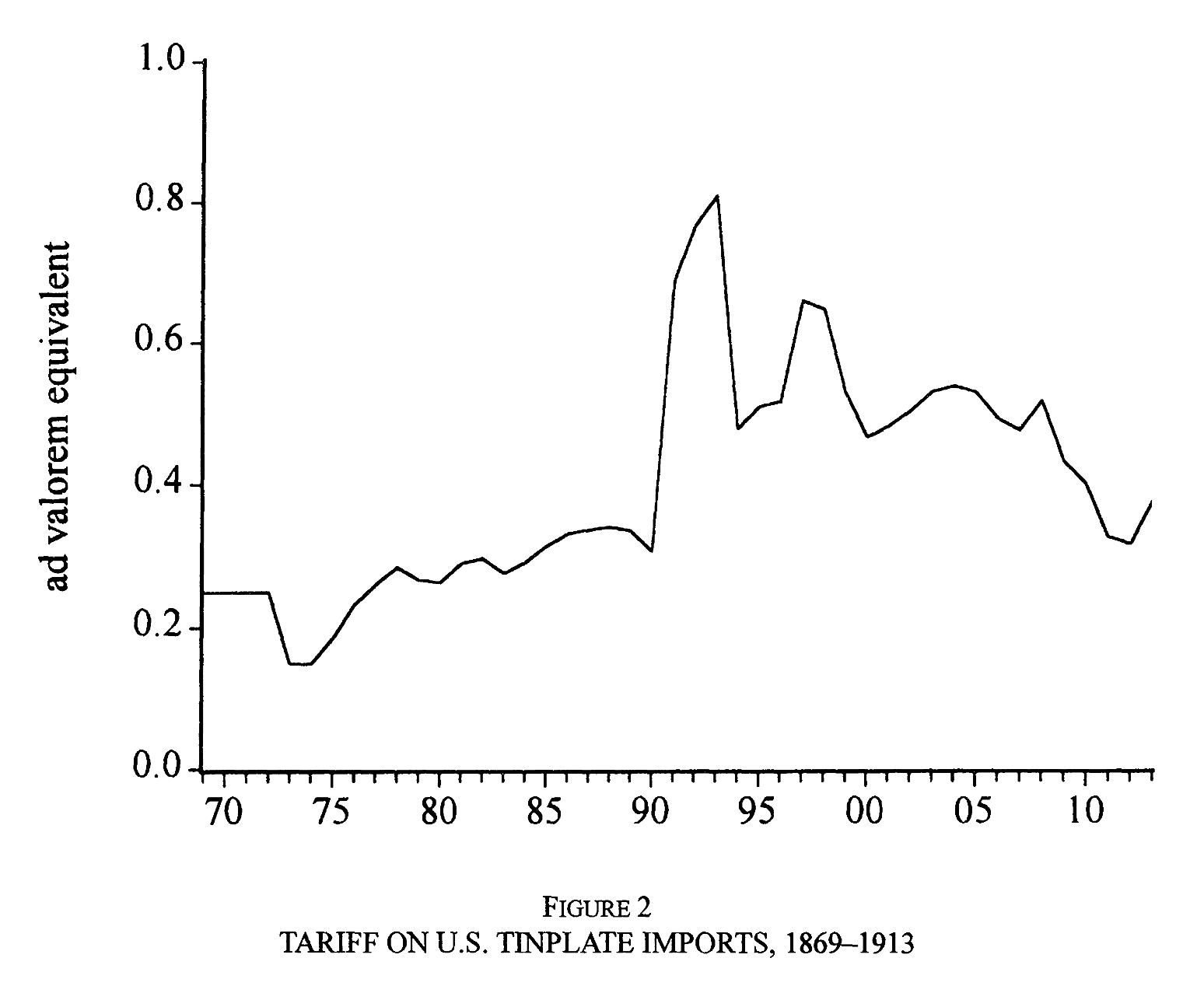
Douglas Irwin studied this case. Irwin’s approach is clever. He builds a model of firm entry/exit and estimates a model of when domestic tinplate production would become viable.
His conclusion? Without the 1890 tariff, the U.S. tinplate industry would still have emerged, just about a decade later. The key input, steel sheet, was becoming cheaper due to improvements in steelmaking; by around 1900, U.S. steel prices would have dropped enough to make domestic tinplate competitive even without protection.
The tariff essentially accelerated this industry’s birth by a decade. But—and this is crucial—Irwin finds that “the protection did not pass a cost-benefit test.” American consumers paid higher prices during the 1890s, and those costs exceeded the benefits of having domestic production a bit earlier.
Even more telling is an irony Irwin notes: prior attempts to start tinplate production in the 1880s had failed partly because other U.S. tariffs on steel made inputs too expensive. As Irwin put it, it was “always steel” that was the bottleneck, a protected upstream industry hindering a downstream one. This highlights the interactions between tariffs across the supply chain.
The tinplate case illustrates a broader point: tariffs can accelerate industrial development, but often inefficiently. Even in what appears to be one of the best cases for protection, the costs outweighed the benefits. Is this the type of “success” that drove the U.S. to the economic frontier by World War I? That seems highly unlikely.
The Growth Decomposition: What Actually Drove U.S. Success?
Another way to really understand America’s growth in this period is to break down its components. Maddison’s data (studied by Irwin 2001) shows that from 1870-1913, real GDP grew at an impressive 3.94% annually in the United States versus 1.90% in the United Kingdom.
However, this impressive expansion was largely due to:
Population growth (2.09% in the U.S. vs 1.21% in the UK)
Capital accumulation (5.53% growth in capital stock vs 1.73% in the UK)
After accounting for these factors, the “total factor productivity” residual—measuring the efficiency with which an economy uses its resources—was remarkably similar: 0.33% in the U.S. and 0.31% in the U.K.
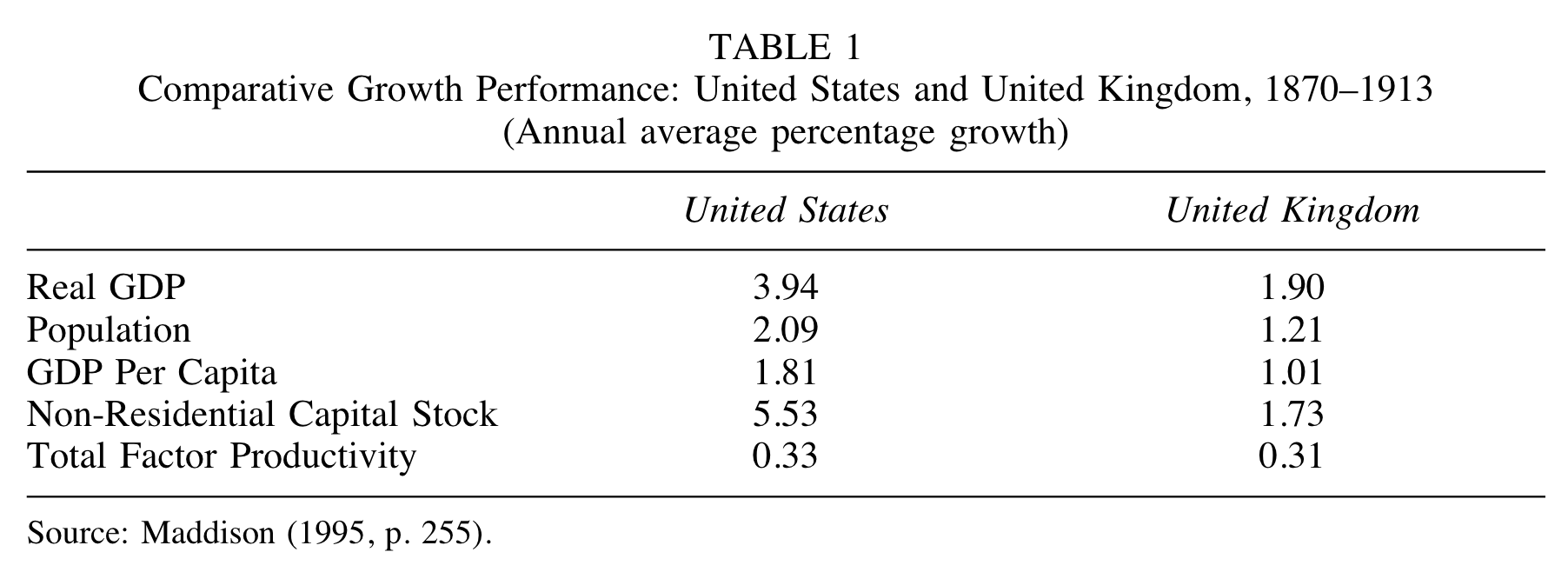
This is a crucial insight: the U.S. outgrew the UK mainly because it threw more resources into production, not because it was achieving greater productive efficiency through protection. As Irwin notes, this growth pattern was “more the result of capital deepening, arising from high rates of saving and investment in which current consumption was sacrificed for future production, than achieving greater productive efficiency.”
Now, this could just kick the question back one level. Why was there so much capital deepening? Could tariffs have generated capital deepening? Sure. But a closer look at other evidence makes this an unlikely explanation.
Non-Traded Sectors: The Overlooked Heroes
Most pro-tariff arguments focus on manufacturing, but that sector’s role may be exaggerated. Productivity growth in non-traded sectors like transportation (2.8% annually), utilities and communications (2.0%) was much higher than in agriculture (0.8%) or even manufacturing (1.2%).2
The rapid productivity growth in these non-traded sectors is usually explained by specific technological innovations, none of which depended on tariffs. U.S. productivity in construction, utilities, transportation and communication, and distribution essentially doubled relative to that in the UK between 1870 and 1910.3 It’s difficult to conceive how this striking development was brought about by high import tariffs.
The non-traded sector also accounted for a rising share of the U.S. labor force, increasing from 31% of employment in 1870 to 43% in 1910. The non-traded sector therefore played a very important role in the United States overtaking the United Kingdom in per capita GDP around the turn of the century.
I hear there are other countries besides the U.S.
There’s another way to get around the N=1 problem. We don’t need to rely on just U.S. data to learn about the average effects of tariffs, while acknowledging each case is its own special snowflake.
Economic theory has long identified channels through which freer trade can boost growth: greater competition spurs efficiency; larger markets enable firms to exploit economies of scale; consumers gain access to cheaper inputs and a wider variety of technologies; and exposure to global best practices can stimulate innovation. At the same time, theory acknowledges that under certain conditions (such as infant industries, externalities, or improving terms of trade for big countries), temporary protection might foster development. The question is fundamentally empirical: on average, have countries that opened their economies experienced faster growth than those that protected?
Early empirical studies, notably in the 1990s, found a strong positive association between trade openness and growth. For example, Sachs and Warner showed that open economies grew substantially faster than closed ones in the post-1945 period. As will all the early cross-country regression papers, these findings were challenged on methodological grounds. Here, in particular, Rodríguez and Rodrik argued that the openness measures were flawed and results were driven by other policies or initial conditions. Their “skeptic’s guide” cautioned that once factors like institutions, macroeconomic stability, or geography are accounted for, the simple trade-growth link often loses significance.
That stuff was all before modern causal inference but prompted a wave of more careful research in the 2000s and 2010s. Douglas Irwin’s 2019 review examines three strands of recent research:
Cross-country growth regressions that focus on within-country changes,
Case studies using synthetic control methods (comparing liberalizing countries to a synthetic doppelgänger that didn’t liberalize), and
Microeconomic studies of productivity channels.
The dust has somewhat settled on that debate at this point. Across these approaches, a consistent finding emerges; major trade reforms that significantly reduce tariffs and other barriers tend to lead to faster economic growth on average.
In other words, countries that opened up saw meaningful improvements in their growth trajectories relative to what we’d predict otherwise. Importantly, the effects differ across countries: some nations gained enormously from trade reform, others less so. The impact seems to depend on complementary conditions (like infrastructure, education, or institutions) and the specifics of what was liberalized. But overall, the evidence is no longer as agnostic as it appeared in 2000; it leans toward the view that freer trade is generally beneficial for long-run growth.
To illustrate, many developing countries in the 1980s–1990s undertook trade liberalization as part of broader reforms. Researchers using synthetic control methods (which create a weighted combination of other countries to simulate the counterfactual) have found that, for instance, India’s dramatic 1991 tariff cuts or Vietnam’s 1986–90 “Đổi Mới” reforms led to higher GDP per capita than if those countries had remained closed.
The more compelling evidence is the micro studies. They show that tariff reductions lead to productivity gains at the firm and industry level, often by weeding out less efficient producers and forcing survivors to modernize. For example, lower tariffs on inputs allow companies to access better intermediate goods, and increased import competition pushes domestic firms to improve their techniques. Topalova and Khandelwal study “India’s rapid, comprehensive, and externally imposed trade reform to establish a causal link between changes in tariffs and firm productivity. Pro-competitive forces, resulting from lower tariffs on final goods, as well as access to better inputs, due to lower input tariffs, both appear to have increased firm-level productivity, with input tariffs having a larger impact.” Amiti and Konings looked at trade liberalization in Indonesia and found similar effects. The channels to growth thus include both one-time efficiency gains and ongoing innovation. This is extremely well-documented in the trade literature.
What Actually Drove Growth?
So the studies about the U.S. don’t find strong evidence that the tariffs were important. The cross-country studies cast doubt on the importance of tariffs.
If tariffs weren’t the magic ingredient, what made America’s economy boom? The empirical literature points to several fundamental drivers:
Factor Accumulation
The U.S. enjoyed extraordinary population growth, fueled by high birth rates and immigration. Capital accumulation was also rapid; railroads, factories, and cities were built at a furious pace. Irwin emphasizes that late 19th-century U.S. growth “hinged more on population expansion and capital accumulation than on productivity growth.”
Ironically, tariffs may have actually hindered capital formation. Irwin notes that tariffs likely raised the cost of imported capital equipment, which may have stunted investment to some degree.
Natural Resources and Scale
The U.S. possessed abundant natural resources (fertile land, forests, and enormous high-quality iron ore deposits in Minnesota) that dramatically reduced steel-making costs in the 1890s. Klein and Meissner note that “natural resources may have mattered more than tariffs.” The U.S. could undercut foreign producers simply thanks to its rich resource endowments.
Geographic isolation also provided a form of “natural protection.” Shipping goods across the Atlantic still incurred cost and time, especially for bulky goods.
Technological and Organizational Innovations
The American System of Manufacturing (interchangeable parts, assembly techniques) was a home-grown innovation that boosted productivity across industries. These innovations were often spurred by factor price. Expensive labor relative to land/capital pushed Americans to invent labor-saving methods.
Stephen Broadberry’s research provides another revealing insight: America overtook Britain not by out-performing in manufacturing productivity initially, but by dramatically improving productivity in agriculture and services and reallocating labor out of farming. By 1890, the U.S. had far fewer people on farms than in 1870, and those people moved to industry and services in cities where they produced more output per worker.
Why Today’s Tariffs Will Be Even Worse Than Yesterday’s
If high tariffs didn’t make America rich in the 19th century, they certainly won’t make us rich today. In fact, there are compelling reasons to believe that Trump’s “Liberation Day” tariffs will be even more economically harmful than their historical predecessors.
I’ve written this all before.
But the fundamental difference lies in how production is organized today versus 150 years ago. In the 19th century, most goods were made entirely within one country. Cotton might be grown in the American South, spun into yarn in New England, woven into fabric in Massachusetts, and sewn into clothing in New York. This relatively simple production chain meant that when a tariff was placed on imported textiles, it primarily affected finished goods.
Today’s global economy looks nothing like this. Modern production is sliced into dozens, sometimes hundreds, of specialized steps across multiple countries. The iPhone (often cited in trade debates) has components from more than 40 countries before final assembly in China. Boeing’s 787 Dreamliner includes parts from at least 15 countries. Even “American-made” cars typically contain 40-50% foreign content.
Tariffs in our modern economy function primarily as taxes on intermediate goods that manufacturers use. Apple designs iPhones in California but contracts manufacturing to hundreds of suppliers across Asia. When tariffs are applied to these imports, they directly affect a major U.S. producer. The clean divide between domestic and foreign firms that exists in textbook models simply doesn’t reflect reality.
A substantial portion of international trade now occurs within multinational corporations rather than between independent buyers and sellers. Roughly half of U.S. imports and nearly a third of exports are between “related parties” - essentially different branches of the same company. Any tariff on this trade is paid directly by U.S. companies.
This fragmentation of production into global value chains creates at least three ways today’s tariffs are worse than historical ones:
Cascading Costs Through the Supply Chain
When we impose tariffs on intermediate inputs, the costs compound as goods move through production stages. A 10% tariff on steel doesn’t just raise the price of steel by 10%; it raises the price of car parts that use steel, then the cars that use those parts, and so on. This “cascading” effect means the final impact on consumer prices can be substantially larger than the nominal tariff rate.
Research on Trump’s first-term tariffs found that companies absorbed only about 20% of the tariff costs. The rest were passed along to downstream businesses and ultimately consumers. This cascade effect becomes more severe the more border-crossing and globally integrated the supply chain.
Kneecapping Our Own Exporters
In the 19th century, U.S. exporters were primarily selling raw materials and agricultural goods - products with minimal imported content. Today’s exporters rely heavily on imported components. When Boeing exports a plane, it first imports countless specialized parts. Tariffs raise input costs for U.S. exporters, making them less competitive globally.
The 2018-2019 U.S.-China trade war already demonstrated this effect. Handley, Kamal, and Monarch found that products more exposed to tariffs on imported inputs experienced significantly lower export growth - equivalent to foreign countries imposing a 2% tariff on U.S. exports. On average, exports of unaffected products grew two percentage points faster than affected items. The tariffs intended to protect domestic industries ended up acting as a tax on U.S. exporters, undermining their global competitiveness - the opposite of protecting American jobs.
Damaging Productivity Through Decreased Specialization
The core economic benefit of trade comes from specialization and comparative advantage. Global value chains take this to the extreme, allowing hyper-specialized production of components where they can be made most efficiently.
The 19th-century tariffs likely reduced productivity by shielding domestic companies from competition. Today’s tariffs do that too, but they also destroy the productivity gains that come from specialization. When firms must source locally to avoid tariffs, they often get lower quality, higher-priced inputs than the specialized global alternatives.
The detailed research shows that in our world of global supply chains and multinational production, major tariffs are likely to be far more damaging—especially to manufacturing jobs—than even basic economics would suggest.
So What?
Why should we care about getting this history right? Because misreading the past leads to misguided policies in the present.
Oren Cass and others have invoked 19th-century U.S. history to argue that tariffs made America great by nurturing industries until the nation became an industrial leader. According to this view, the United States followed an alternative path to Britain’s free-trade gospel, using the “American System” of high tariffs to build its manufacturing base.
But the evidence suggests that tariffs were, at best, a minor contributor to U.S. growth and, at worst, a hindrance. The 19th-century U.S. growth “miracle” was multifaceted, and tariff policy was, at most, a supporting actor—and possibly a bit of a villain—in the story.
The real lesson from economic history is that sustainable growth comes from increasing overall productivity and capabilities. Smart industrial policies might selectively nurture emerging industries, but blanket high tariffs are more likely to breed inefficiency and complacency.
America’s economic greatness wasn’t simply manufactured behind tariff walls. It was forged through entrepreneurship, innovation, and the fruitful deployment of resources on a continent rich with opportunity. Tariffs were a facet of the era’s policy landscape, but not a meaningful cause, let alone the keystone, of growth.
Don’t let people hand-wave about tariffs in the 19th century. The historical evidence is about as clear as anything pre-20th century economic history: America’s economic rise wasn’t driven by tariffs. As Irwin summarized, “A lot of other factors were involved and the tariffs were probably third or fourth order. And it’s not even clear they had a positive impact as opposed to a negative impact.” And today’s far more interconnected economy makes protective tariffs even more damaging.
Irwin, Douglas A. "Tariff Incidence in America's Gilded Age." The Journal of Economic History 67.3 (2007): 582-607
Kendrick, John W. “Productivity Trends in the United States.” In Productivity Trends in the United States. Princeton University Press, 1961. https://www.nber.org/books-and-chapters/productivity-trends-united-states/front-matter-productivity-trends-united-states.
Broadberry, Stephen N. “How Did the United States and Germany Overtake Britain? A Sectoral Analysis of Comparative Productivity Levels, 1870-1990.” The Journal of Economic History 58, no. 2 (1998): 375–407.